
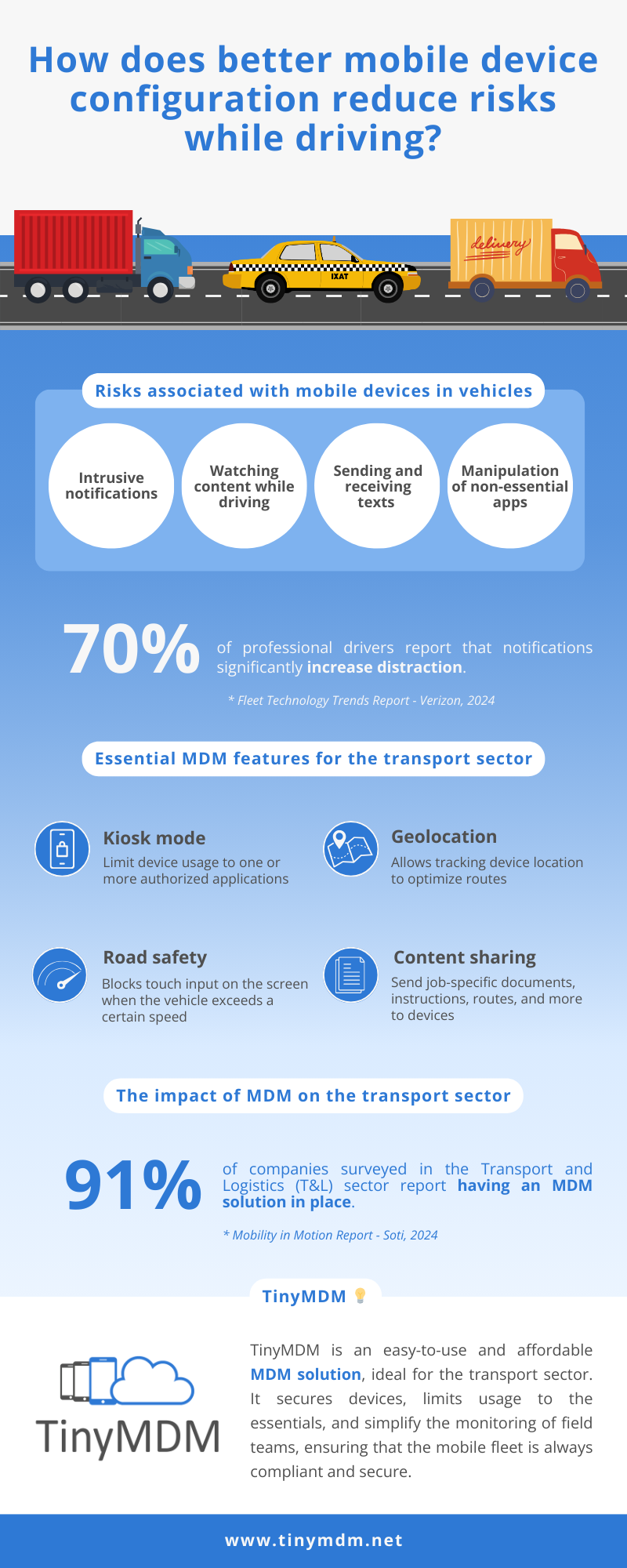
The proliferation of mobile devices has introduced significant safety challenges on the road, with driver distraction emerging as a leading cause of accidents. The risks come from the features that make smartphones useful: intrusive notifications, the temptation of watching content while driving, the temptation to send and check received texts, and the simple act of manipulating non-essential apps (such as social media or games). These activities shift the driver’s focus from the task of driving, which cause a critical lapse that can have severe consequences, even during brief moments of inattention. It is therefore important to implement a mobile configuration to reduce risks on the road.
The role of Mobile Device Management (MDM) to reduce risks while driving
To actively reduce these risks, Mobile Device Management (MDM) solutions offer powerful configuration tools that enforce a safe driving environment. An effective MDM strategy fundamentally reconfigures the device’s behavior when the user is behind the wheel. Key features include Kiosk Mode, which locks the device into a limited, driver-specific interface, permitting only essential and approved applications like navigation or hands-free calling. This directly eliminates the ability to access non-essential apps.
Furthermore, thanks to a geolocation feature, the Android MDM software can automatically see where the device is and see a three-day geolocation history. Also, on TinyMDM you can automatically block touch on the screen above a certain speed.
By configuring devices this way, organizations and individuals can significantly reduce the potential for distracted driving incidents, reducing risks on the road.
25th of November 2025